How Much Does Sewer Line Repair Cost in NYC? (2026 Guide)
August 20, 2026Plumbing Problems Unique to NYC Pre-War Buildings (and How to Fix Them)
September 3, 2026Quick answer:
Trenchless sewer repair fixes a damaged sewer line without digging up your yard, driveway, or sidewalk. A plumber uses pipe bursting or CIPP lining to rebuild the pipe from the inside, working through one or two small access points. It usually costs less than open-trench work once you count restoration, and it finishes faster.
A cracked or collapsed sewer line used to mean one thing: a trench across your yard, your driveway, or your sidewalk. That’s still true for some jobs. But most NYC homes now qualify for trenchless sewer repair, a method that fixes the pipe from the inside and skips the excavation almost entirely.
If you’re comparing your options after a sewer inspection, this guide covers how trenchless methods actually work and why they tend to save money once the full job is priced out. It won’t walk you through the full repair-versus-replacement decision or give you an itemized price list — those live elsewhere. For the full repair-versus-replacement decision, see our guide on sewer line repair vs. replacement in NYC. For a general look at signs your line is failing, see our warning signs guide.
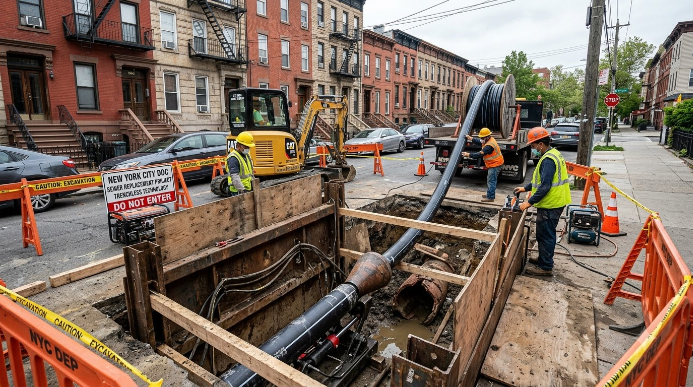
How Trenchless Sewer Repair Works
Trenchless repair covers two main methods. Both avoid the long trench a traditional dig requires.
Pipe Bursting
Pipe bursting replaces the old pipe with a new one in a single pass. Here’s the sequence:
A plumber digs two small access pits, one at each end of the damaged run. A cable connects the pits, running through the old pipe. A bursting head then gets pulled through that old pipe. The head cracks the old pipe outward while pulling a new pipe in behind it. Once the new pipe is seated, the crew backfills both access pits and reconnects the line.
The result is a brand-new pipe, usually one size larger than the original, running the same path the old one did. This works well when the old pipe has collapsed sections, root intrusion, or is too damaged for a liner to hold its shape inside.
CIPP Lining (Cured-in-Place Pipe)
CIPP takes a different approach. Instead of replacing the pipe, it rebuilds the inside of it.
A flexible liner soaked in resin gets pulled or inflated into the damaged pipe through an existing access point, often a cleanout or a single small pit. The liner is then cured in place, using hot water, steam, or UV light, depending on the crew’s equipment. Once cured, it hardens into a smooth new pipe wall inside the old one.
CIPP is the better fit when the old pipe still has its shape and the main problem is cracks, small offsets, or interior corrosion, not a full collapse.
Both methods need a camera inspection first. A plumber has to see the full condition of the line. Only then can they recommend pipe bursting over CIPP, or confirm the line qualifies for a trenchless approach at all. Some problems rule trenchless out. Severe collapse, major misalignment, or a pipe that’s shifted out of grade all point back to a traditional dig instead.
| Factor | Pipe Bursting | CIPP Lining |
|---|---|---|
| What it does | Replaces the old pipe entirely | Rebuilds the inside of the existing pipe |
| Best for | Collapsed sections, root intrusion, undersized pipe | Cracks, small offsets, interior corrosion |
| Access needed | Two small pits, one at each end | One access point, often an existing cleanout |
| Pipe size after repair | Often one size larger than before | Same size, minus liner thickness |
| Not a fit when | No rough path remains through the old pipe | Pipe has lost its round shape or collapsed |
Not sure which method fits your line?
Call 646-580-7524 Get a Free Quote✓ Licensed & Insured ✓ Camera Inspection First ✓ Upfront Pricing
Why Trenchless Sewer Repair Saves You Money
The pipe material and labor for a trenchless job aren’t always cheaper than a traditional dig on their own. The savings show up around the job, not in it.
A traditional sewer replacement means breaking up whatever sits on top of the line. In NYC, that’s often a driveway. It could be a finished yard, a stretch of sidewalk, or in some blocks, the street itself. Every one of those has to come back afterward. That means new concrete, new asphalt, and new landscaping. It can also mean a new DOT sidewalk permit stacked on top of the DEP sewer permit. That restoration work can rival the cost of the pipe repair itself.
Trenchless methods skip almost all of it. Two small pits replace one long trench. That means less concrete to break and less to pour back. The footprint to restore is smaller too. Fewer crew-days on site also means less disruption. That matters if you’re running a business out of the property. It matters just as much if you’re trying to keep a household running during the work.
Speed adds to the savings too. A traditional dig can mean a full week of digging, pipe-laying, and backfill. A trenchless job often finishes in one to two days once the access pits are open. Less time on site means less exposure to surprise costs. Hitting another utility line mid-dig is a real risk in NYC’s dense underground, and it’s a cost trenchless work mostly avoids.
None of this means trenchless is automatically the cheaper option on every job. Picture a shallow, short run under an unfinished Staten Island yard. There’s not much to restore either way, so the two methods can land close in price. Now picture a deep line running under a finished Brooklyn brownstone’s front garden and stoop steps. That’s where trenchless usually pulls ahead. The restoration bill for a traditional dig in that spot would be steep. For the full, itemized cost breakdown by method, depth, and length, see our 2026 NYC sewer line repair cost guide once it’s published.
When Trenchless Isn’t the Right Call
Trenchless repair isn’t a fit for every damaged line. A camera inspection can rule it out for:
- A pipe that’s fully collapsed or crushed flat, since pipe bursting still needs a rough path to pull the new pipe through
- Sewer lines that have sagged out of proper grade, called a “belly,” where the slope no longer drains correctly
- Lines with severe offsets at the joints, more than a liner can bridge
- Some older cast-iron or clay lines under NYC’s pre-war housing stock, where the surrounding soil has already shifted the pipe out of alignment
If your line falls into one of these categories, a traditional open-trench replacement is usually the honest answer. We won’t stretch a trenchless method past what it can actually fix just to sell you the newer-sounding option. Our sewer line repair pillar page covers both methods side by side if you’re still deciding which one applies to your situation. Our repair-vs-replacement guide walks through the fuller decision if your inspection turns up more than one issue.
Get a Camera Inspection Before You Decide
The only way to know if your sewer line qualifies for trenchless repair is a camera inspection. Guessing from symptoms alone isn’t enough to pick a method. Slow drains, gurgling, or a wet spot in the yard can point to several different problems, and each one calls for a different fix. A camera run tells us exactly where the damage sits, how bad it is, and whether the pipe still holds its shape.
Call 646-580-7524 and we’ll send a licensed plumber to run the camera, show you the footage, and walk you through what it means. You’ll get a straight answer on whether pipe bursting, CIPP, or a traditional dig is the right call for your line, along with your permit and timeline options before any work starts. If you’re upgrading aging pipe elsewhere in the building at the same time, our pipe upgrades and relining page covers that separately.
Does trenchless sewer repair work on old NYC pipes?
Often, yes. CIPP and pipe bursting both work on clay, cast-iron, and Orangeburg pipe, as long as a camera inspection confirms the line hasn’t collapsed or shifted out of grade.
How long does a trenchless sewer repair take?
Most trenchless jobs finish in one to two days once the access pits are open, compared with about a week for a full open-trench replacement.
Do I need a permit for trenchless sewer repair in NYC?
Yes. Trenchless work still requires a DEP sewer connection permit and a licensed plumber, the same as a traditional replacement — the method changes the digging, not the permit requirement.
Can trenchless repair fix a fully collapsed sewer line?
Not usually. Pipe bursting needs a rough path through the old pipe, and CIPP needs the old pipe to hold its shape while the liner cures. A full collapse typically means a traditional dig.
Is CIPP or pipe bursting better for my home?
It depends on the pipe’s condition. CIPP suits lines that are cracked or corroded but still round. Pipe bursting suits lines that are undersized, badly damaged, or need to be upsized. A camera inspection settles which one applies.
Get a Trenchless Sewer Inspection Today
Licensed, insured plumbers serving all five boroughs. Camera inspection first — an honest answer before any digging starts.
Call 646-580-7524 Get a Free Quote